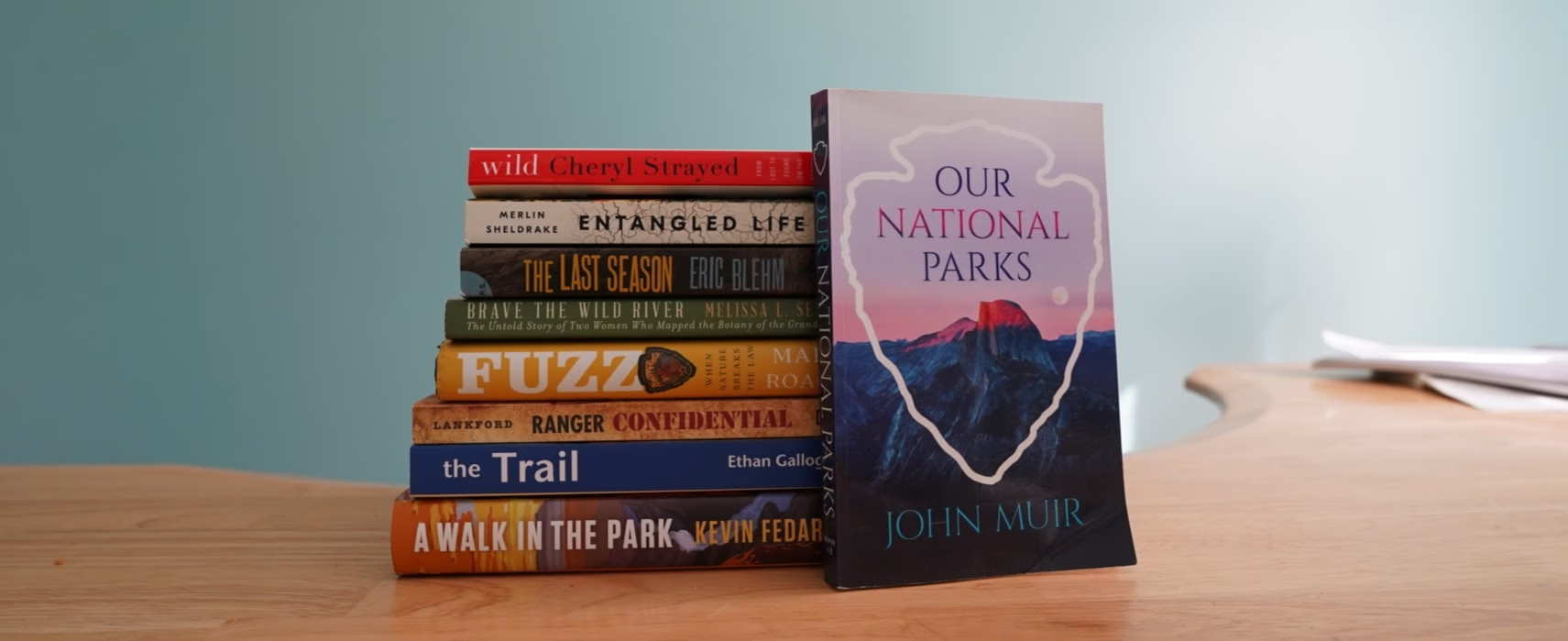
Reading about the National Parks, and the people and species who inhabit them, shape them, and make them what they are, is perhaps the next best substitute for actually being in a park itself. The range of National Park books, including fiction and non-fiction narratives as well as those that detail the natural history and geology of the parks themselves, are a great way to ramp up excitement about an upcoming trip and enhance the in-person experience with insider knowledge found within the pages.
Like everything I write about on this site, the book reviews and synopses on this reading list come directly from my experience, which is to say, I’ve read each and every page. My reading list is not finite and I continuously add to this list as I finish additional worthwhile reads! Search engines may love a list of the top ten best National Park books, but I find it’s also impossible to highlight the ten best books for any individual. Instead, I’ve chosen to review books that fellow National Park lovers will most likely enjoy and leave my recommendations for who within that wide audience any particular book is best suited.
National Park Book Reviews
- Brave the Wild River by Melissa L. Sevigny
- Fuzz: When Nature Breaks the Law by Mary Roach
- The Invention of Nature: Alexander von Humboldt’s New World by Andrea Wulf
- Entangled Life by Merlin Sheldrake
- The Last Season by Eric Blehm
- Ranger Confidential: Living, Working and Dying in the National Parks by Andrea Lankford
- The Trail: a Novel by Ethan Gallogly
- A Walk in the Park: The True Story of a Spectacular Misadventure in the Grand Canyon by Kevin Fedarko
- Wild by Cheryl Strayed
National Park Books Featuring Rangers
Ranger Confidential: Living, Working and Dying in the National Parks by Andrea Lankford
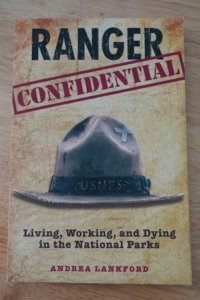
Best For: Those who fantasize about life as a National Park Ranger and fans of National Geographic’s Extreme Rescues television series.
Each of the 32 chapters serve as stand alone short stories that together form a connective narrative of what life was like for a dozen or so enforcement rangers stationed at some of the busiest National Parks within the US, including Yosemite and Grand Canyon. Set in the 1990s and early aughts, the vignettes shared by Andrea Lankford, former park ranger, speak of the challenges faced by women in the role as well as the brutal, and often heartbreaking, situations all rangers face when trying to “protect the park from the people, the people from the park, and the people from themselves.” This book humanizes the civil servants who dedicate their lives to the National Park Service and disabuses any notion that a park ranger career is akin to one glorious extended vacation in some of the most beautiful places on Earth.
The Last Season by Eric Blehm
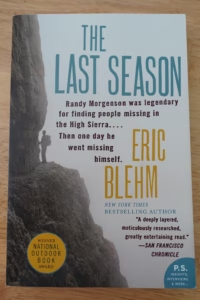
Best For: Those who wish to discover the High Sierras and fans of high stakes investigations
Winner of the National Outdoor Book Award, The Last Season details both the search for and career of seasoned backcountry ranger Randy Morgenson, who spent his life living in, protecting and advocating for the High Sierra. Part mystery and part biography, the chapters oscillate between the events following his disappearance, as Sequoia and Kings Canyon National Parks (SEKI) Rangers painstakingly attempt to locate their friend and colleague, and the formative events in his life leading up to it, documented in part through his daily logs. Morgenson’s own writings, skillfully woven into the narrative by adventure writer Eric Blehm, convey such a deep appreciation for the High Sierra that the reader cannot help but reevaluate their relationship with the natural spaces they travel through. This is a book that will stay with you long after you’ve finished.
Fuzz: When Nature Breaks the Law by Mary Roach
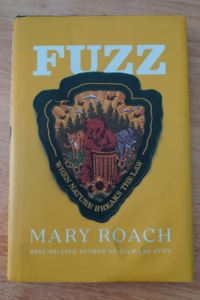
Best For: Those curious about the work of the National Wildlife Research Center and fans of Hulu’s Wild Crime series
It’s said you shouldn’t judge a book by its cover, but this is the exception that proves the rule. Fuzz delves into the fascinating world of human-animal interactions, particularly the antagonistic ones. NYTimes bestselling author and science writer Mary Roach covers the grittier aspects of wildlife management and ecosystem conservation largely hidden from public view: the careful planning required to remove so-called ‘danger trees’ from falling onto and killing the very visitors there to walk amongst said trees; the ethical conundrums of protecting certain species within an environment by eliminating different species deemed to be invasive; and the ever-evolving science behind measuring, monitoring, and managing marauding seagulls, monkeys, cougars, and stoats and keeping deer from getting hit on the road. Each chapter has a focal case study, the conclusion of which seamlessly glides into the start of the next. While the field work itself is often situated on state parks or National Forests outside of National Parks proper, the applicability of the wildlife biologists’ and Fish & Wildlife agencies’ work is instantly recognizable to any park enthusiast. And to those who overheard me reading this aloud one night in the Watchman Campground, I hope you enjoyed learning how to tell the difference between a bear and a mountain lion attack as much as I did.
Books Featuring National Park Journeys
Brave the Wild River by Melissa L. Sevigny
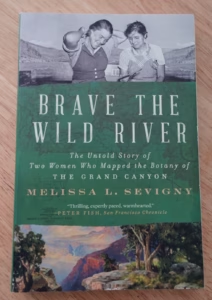
Best For: Those curious about early Grand Canyon explorations and the unsung contributions of women in science
In 1938, as the waters behind the Hoover Dam were still years away from filling Lake Mead and the construction of the Glen Canyon Dam was still decades away, an untamed Colorado River had full reign over through the depths of the Grand Canyon and its network of tributaries. This was the year that Dr. Elzada Clover and then graduate student Lois Jotter, two botanists from the University of Michigan, endeavored to became the first scientists to document the plant life of the inner canyon, running the length of the Colorado from Green River to Lake Mead. Award-winning science writer Melissa L. Sevigny draws extensively from the journals, letters and other first-hand accounts as she takes you into the canyon with Clover, Jotter and the rest of their greenhorn crew. Brave the Wild River is a surprisingly entertaining read, perfectly balancing the travel narrative of river-running with the long overdue recognition of Clover and Jotter’s botanical contributions.
A Walk in the Park: The True Story of a Spectacular Misadventure in the Grand Canyon by Kevin Fedarko
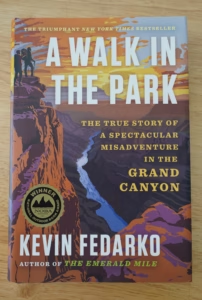
Best For: Those wishing to discover the inner sanctum of the Grand Canyon
Never have two people been so profoundly out of their depth as Kevin Fedarko and his hiking partner, photojournalist Pete McBride, as they embarked on a spontaneous quest to hike the entire length of the Grand Canyon. As such, I found the early chapters infuriating: the level of hubris involved in thinking one could simply ad lib their way through one of the most remote places on earth is a privilege attainable only to a very specific demographic of which I am not member. But as the sentiments of the broader cast of characters began to somewhat mirror my own (arguably the real protagonist is Rich Rudrow, without whom there would be no book to write), I kept at it. As they progressed along their 750 mile route, I progressed through the 435 pages and along the way we both discovered the rich history of the Grand Canyon and its hidden spaces that very few will access.
Wild by Cheryl Strayed
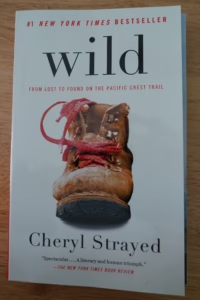
Best For: Those interested in classic hiking tales and memoirs
When Cheryl Strayed thru-hiked a portion of the Pacific Crest Trail (PCT) in 1995, few had even heard of the trail, and when she published her narrative account in 2012, it was one of the first personal narratives to feature long distance hiking. That context is important when reading it now, when the PCT is well known within the outdoor community. For a book that inspired countless people to embark on their own personal journey along one of the nation’s border-to-borders trails, this book is not a how-to; it’s not even really about the PCT, or any of the state and National Parks she hiked through, though they do get a mention here and there. It is first and foremost the memoir of a women who found herself unable to process profound grief and her attempts to find a way through. Experienced hikers will roll their eyes more than once at how completely ill-equipped and unprepared she was for just about every aspect of the journey; it’s truly a wonder she survived at all. But Wild has taken its place in the outdoor literary canon in part due to Strayed’s ability for blunt and honest reflection, and for that reason alone, it’s worth a read.
The Trail: a Novel by Ethan Gallogly
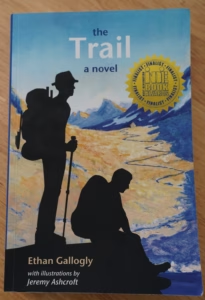
Best For: Those wanting to experience the John Muir Trail (JMT) from the comforts of home
This fictional account, based loosely on author Ethan Gallogly’s real life JMT thru-hike, follows the exploits of a reluctant hiker, Gil, and his incongruous trail mate Syd as they struggle to reach Mt Whitney from Yosemite Valley. At its best, the narrative provides rich descriptions of the landscape coupled with the history of the JMTs creation. For many readers, hiking the trail vicariously in this way will be enough to propel them through the pages at their worst. It was for me. But other times the author assumes the reader has never heard of the JMT, or backpacking at all for that matter, forcing the characters to dispense basic facts about water filters and zero days in such unnatural dialogue you find yourself thinking “here we go again” as your eyes glaze past another pedantic lecture. Most of these conversations are initiated by Gil, the immature, self-absorbed main character whose inner monologue is perhaps the most obnoxious part of the entire book. Gil is the type of person I hope never to have to hike with, and I questioned the judgement of each and every one of the fellow hikers who put up with his nonsense. But his delayed adolescence and bro-ness also reflect an unavoidable reality of trail culture, providing a perspective I hope otherwise never to experience. You may not get to claim the summit yourself at the end, but you will have accomplished a task of equal fortitude: sticking it out will Gil and Co. for over 200 miles so that you can finally part ways.
Books Highlighting Natural History
The Invention of Nature: Alexander von Humboldt’s New World by Andrea Wulf
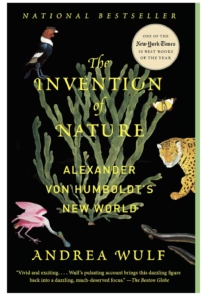
Best For: Those interested in ideas that shape our perception of the natural world
Nearly a generation before John Muir, widely regarded as the Father of the National Park System, there was Alexander von Humboldt, a Prussian-German naturalist whose geographic explorations of South America would lead to modern environmental science and the field of biogeography. Humboldt was the original outdoor influencer, inspiring the minds of Darwin, Muir and Thoreau, as well as statesmen Simon Bolivar and Thomas Jefferson. In an age when the natural world was largely understood in terms of taxonomic classification, Humboldt recognized the interconnectedness between climate, geography, and speciation. Though he never visited North America, a plethora of places, species, and institutions bear his name – from California’s Humboldt Redwoods State Park to the oceanic Humboldt Current – and after reading this biography, you’ll understand why.
Entangled Life by Merlin Sheldrake
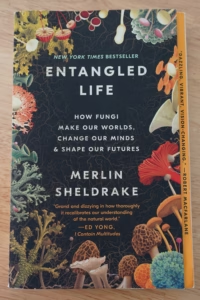
Best For: Those who can’t resisting photographing the mushrooms they see along the trail and other mycophiles
Hidden beneath your feet, responsible for life as we know it, are vast networks of mycelium transporting chemical messages and forming relationships with photosynthetic cells to create ecosystems as we know them. In revealing the secrets of the forest floor, Entangled Life doesn’t have to address any specific National Park in order for the reader to draw connections to their favorite wooded environment – from the appearance of the colorless Ghost Pipe, a mycoheterotrophic species that has stopped photosynthesizing and is instead entirely reliant upon a symbiotic relationship with fungus for energy, to the way fungal networks integrate entire forests into a “fungal commodities exchange” where resources are shared, and information is exchanged. If trees talk via the “Wood Wide Web,” then fungi is the language that they use. Each chapter explores yet another truly fascinating behavior of this largely untapped and unexplored kingdom of life.
What book should I read next? Leave me your National Park book recommendations in the comments below!
1 Comment
Love your book reviews! I want your point of view not some list of “best” by others